The Semiconductor Gold Rush: How AI Just Made Chips Worth $1.6 Trillion (And Why 2026 Changes Everything)
🚀 THE NUMBERS ARE INSANE Let's cut to the chase: the semiconductor market just hit $1.6 trillion. That's not a typo. That's a historic milestone that signals one of the most fundamental shifts in te...

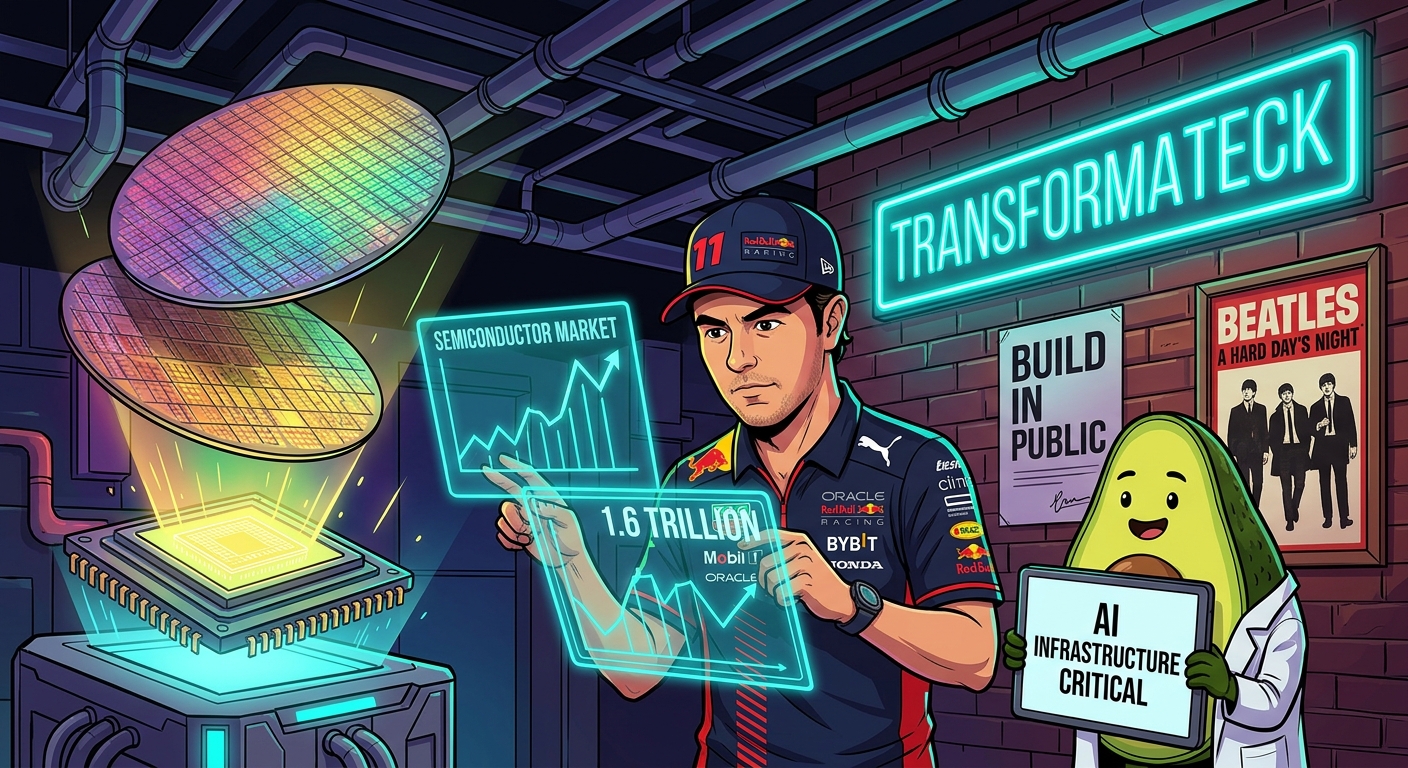
🚀 THE NUMBERS ARE INSANE
Let's cut to the chase: the semiconductor market just hit $1.6 trillion. That's not a typo. That's a historic milestone that signals one of the most fundamental shifts in tech infrastructure we've witnessed in decades. And AI? It's the rocket fuel behind every single percentage point of growth.
But here's what most people get wrong: when they talk about AI, they imagine code, algorithms, neural networks dancing in the cloud. The reality is way more visceral. AI requires HARDWARE. Massive, specialized, power-hungry hardware that doesn't exist without semiconductors. GPUs, TPUs, custom silicon—these aren't luxuries anymore. They're the literal foundation upon which the entire AI economy stands.
⚡ WHY THIS MATTERS RIGHT NOW
We're not just talking about bigger data centers. The semiconductor explosion reflects an unprecedented demand for chips that can handle AI training and deployment at scale. Data centers worldwide are burning through specialized processors like never before. Companies like Qualcomm aren't waiting around—they're already embedding AI directly into consumer devices. Their Horizon Ultra AI PC is just the beginning of a massive shift from centralized computing to edge computing, where intelligence lives on your device, not in someone else's cloud.
Translate that trend across billions of devices globally, and suddenly you understand why chip manufacturers are in a feeding frenzy. The demand isn't cooling down. It's accelerating.
🔥 THE HIDDEN BOTTLENECKS NOBODY'S TALKING ABOUT
Here's where it gets interesting—and slightly terrifying if you're a supply chain manager. The semiconductor growth is real, but it's being strangled by invisible chokepoints that don't show up in headlines.
First: optimized software. Having powerful chips means nothing if your code isn't written to leverage them. This is becoming a real constraint.
Second: digital twins. Companies are using simulation technologies to test chip behavior before mass production, but the simulation infrastructure itself is becoming a bottleneck. You need semiconductors to simulate semiconductors. It's inception-level complicated.
Third: cooling systems. High-performance chips generate insane amounts of heat. Advanced refrigeration solutions have become critical infrastructure, but they're not scaling as fast as chip production. Data center operators are literally fighting thermal battles that limit how much hardware they can deploy.
These three challenges? They're the real limit to AI's growth trajectory right now. It's not chip availability—it's the ecosystem around them that's choking.
🎯 THE EDGE COMPUTING REVOLUTION
Qualcomm's move toward AI-enabled edge devices signals a seismic shift in how we'll process information going forward. Instead of sending everything to centralized servers, computation happens locally. On your phone. On your car. On your smartwatch. On your factory floor sensors.
This isn't just more convenient. It's exponentially more demands for specialized semiconductors. Every edge device needs its own AI-capable processor. Multiply that across wearables, IoT devices, autonomous systems, and industrial equipment, and you're looking at a semiconductor demand curve that goes vertical.
The $1.6 trillion market size? That might actually be conservative when edge computing fully saturates by 2026.
🏗️ WHY 2026 IS THE CRITICAL YEAR
The infrastructure race is accelerating because companies understand one brutal truth: whoever controls the semiconductor supply chain controls the AI revolution. By 2026, we'll see which nations, which companies, and which technologies truly dominated the transition.
Chip manufacturers are racing to build capacity. Data center operators are racing to deploy cooling systems. Software companies are racing to optimize for specialized hardware. It's a three-front war, and the losers get left behind.
Investors should be watching the semiconductor space obsessively. This isn't about quarterly earnings—it's about which players will own the physical infrastructure of the next decade.
💡 THE BOTTOM LINE
AI isn't magic. It's engineering. Billions of transistors, orchestrated across specialized silicon, cooled by advanced systems, optimized by brilliant software. The $1.6 trillion semiconductor market is the physical proof that artificial intelligence has moved from theoretical to absolutely, undeniably real.
The race is on. The stakes are insane. And if you're not paying attention to the chip layer of the AI stack, you're missing the most important story in tech right now.
📱 STAY LOCKED IN WITH TRANSFORMATECK
This is exactly the kind of infrastructure-level insight that separates people who understand tech from people who just read headlines. Our WhatsApp community Transformateck is where 600+ members discuss this stuff daily—no fluff, just raw analysis of what's really happening in silicon valleys worldwide.
We're aiming for 1,000 members of serious tech builders and investors. If you want to be part of conversations about semiconductor supply chains, AI infrastructure bottlenecks, and where the real value is hiding, join us. Real insights. Real people. Real impact.
We're building in public, and we'd love to have you in the room.
#AI #Semiconductors #TechInfrastructure #EdgeComputing #FutureOfTech
Kevin Garza
Miembro de la comunidad de IA de Transformateck, compartiendo conocimiento y experiencias para impulsar la inteligencia artificial en Latinoamérica.